 Shirakawa-go Village Tours
Home › Guides › Shirakawa-go in Winter: Snow, the Light-Up and How to Go
Shirakawa-go in Winter: Snow, the Light-Up and How to Go
Visiting Shirakawa go in winter means deep snow on the gassho roofs, with February snow of 170 cm or more, and four Light-Up evenings in January that admit only visitors with an advance reservation. This guide covers the Light-Up dates and access rules, getting there on snowy roads, what to wear, how long to stay and the winter tours, such as the $226.17 two-day trip from Osaka.
Quick answer Is Shirakawa-go in winter worth it, and how do you go?
Yes, Shirakawa-go is worth visiting in winter: February snow can reach 170 cm or more, and the village is lit from 17:30 to 19:30 on 11, 17, 24 and 31 January. The Light-Up admits only visitors with an advance reservation, and no tickets are sold on the day. A tour with a Light-Up departure, a lottery-won room or a reserved parking slot are the ways in.
Key takeaways
- Browse every Shirakawa-go tour, including winter departures.
- The Shirakawa-go and Takayama Day Tour from Nagoya runs a Light-Up departure on all four January dates.
- The 2-Day Shirakawa-go and Hida no Sato Winter Tour from Osaka sees the Hida no Sato light-up in Takayama, not the village Light-Up.
- No reservation, no entry: read how Light-Up tickets work.
Winter Tours to Shirakawa-go
The card below is a two-day winter trip from Osaka with a hotel night, breakfast and day-one lunch included. It visits Shirakawa-go by day and an evening light-up at Hida no Sato, the folk village in Takayama, not the Shirakawa-go Light-Up. For the village Light-Up itself, see the tours named in the Light-Up section.
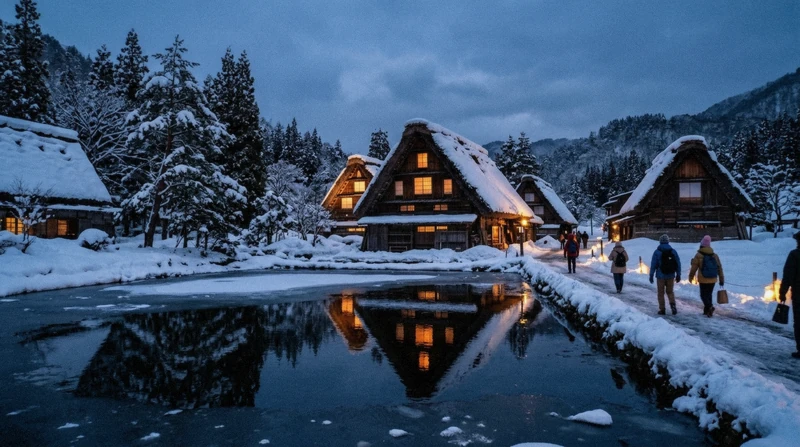 from $226.17
Winter overnight
2-Day Shirakawa-go and Hida no Sato Winter Tour from Osaka
Two days from Osaka in winter: Shirakawa-go in the snow, Takayama old town, a hotel night and the Hida no Sato light-up.
Check AvailabilityIs Shirakawa-go worth visiting in winter?
Yes, the deep snow and the January Light-Up make winter the most photographed season, and also the most demanding one to plan.
Winter is when the gassho-zukuri farmhouses look the way they do in every famous photograph. It is also when access gets complicated, so it helps to know both sides before you book.
Why winter is the best-looking season
February snow in Shirakawa-go can reach 170 cm or more, with a recorded maximum of 4.5 m, and the steep thatched roofs are built for exactly that. Gassho-zukuri means prayer-hands construction. The nail-free frames are flexible, and the attics were once used to raise silkworms. Snow slides off the steep pitch instead of crushing the house.
On four evenings in January, 11, 17, 24 and 31 January, many of the farmhouses are lit from 17:30 to 19:30. It is the biggest draw of the snow season, and entry is by advance reservation only.
What makes winter harder
Light-Up nights can fall to about -10 to 0 degrees Celsius, so the organisers advise warm clothing, anti-slip footwear and a flashlight. Roads and paths are snow covered and sometimes icy, and some village paths have uncovered water channels. Some guesthouses, museums, restaurants and cafes keep limited hours or close in winter.
None of this cancels the trip. Wear proper gear, watch your footing and check opening times before you go.
Sources: Shirakawa-go Tourist Association, Shirakawa-go Tourist Association.
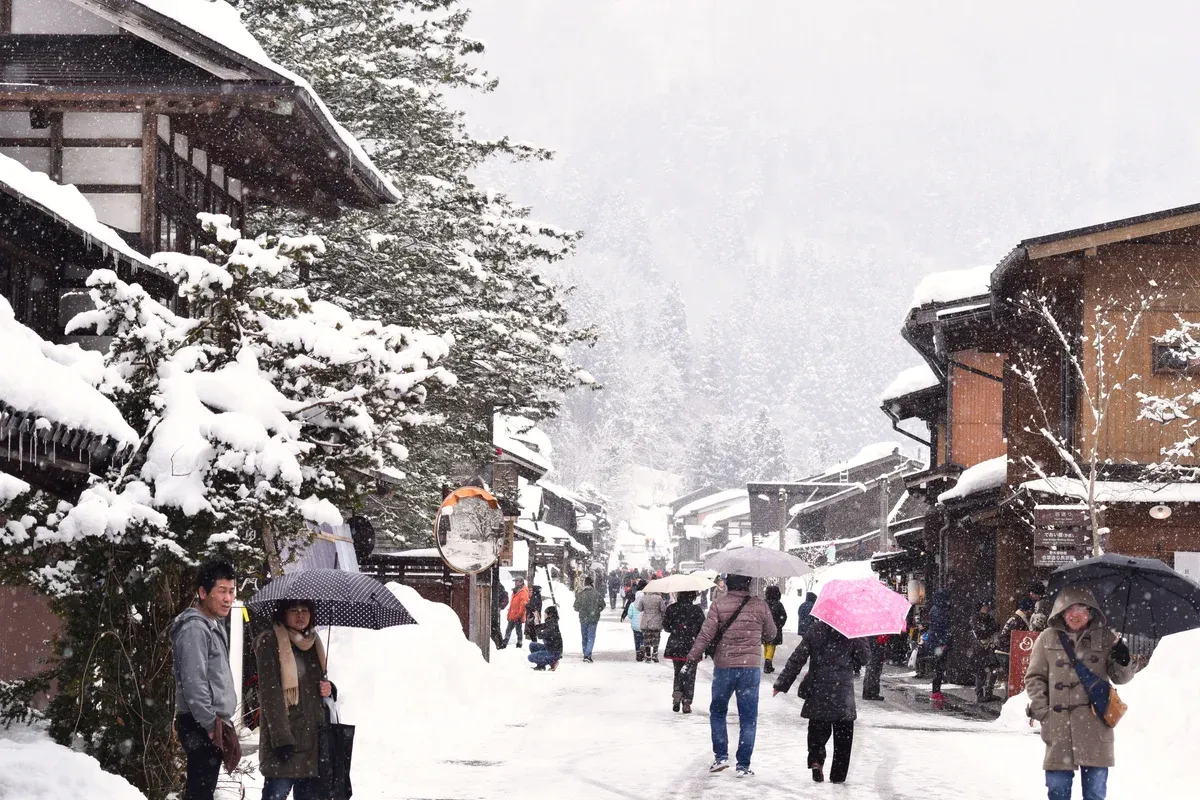
Ogimachi's main street during a February snowfall. Photo: 雷太, CC BY 2.0, via Wikimedia Commons
How does the 2-Day Shirakawa-go and Hida no Sato Winter Tour from Osaka compare with going alone?
The 2-Day Shirakawa-go and Hida no Sato Winter Tour from Osaka costs $226.17 per person and removes the winter driving, while going alone means reserving bus seats or parking yourself.
There are three ways to reach the village in winter: an organised tour, a highway bus or your own car. The table sets them side by side for a snow-season visit.
Your three winter options compared
The table compares the tour, the bus and a car on price, length, what is included and group size, from the tour listing, Hokutetsu and the Light-Up committee. The tour is operated by H.I.S., rated 4.9 from 11 reviews, with free cancellation up to 3 days before departure.
| Option | Price | Length | Included | Group size |
|---|---|---|---|---|
| 2-Day Shirakawa-go and Hida no Sato Winter Tour from Osaka | $226.17 per person | 2 days | Hotel night, breakfast, day-one lunch and Hida no Sato light-up entry, dinners extra | Max 40 people |
| Highway bus, here from Kanazawa on Hokutetsu | $17.69 (¥2,800) one way, adult | About 1 hour 20 minutes each way | A reserved seat only | Independent |
| Own car on a Light-Up day | Reserved parking round 2: $44.23 (¥7,000) for 1-5 people, $63.19 (¥10,000) for 6-10 | Entry from 15:00, out by 20:00 | Parking only, studless winter tyres required | Your own party |
Source: Shirakawa-go Tourist Association.
What does a winter day in Shirakawa-go look like?
A good winter day walks the village lanes, climbs to the Shiroyama observation deck, opens one or two farmhouses and the open-air museum, and ends with hot local food.
The tourist association puts a walk around the village at 2 to 3 hours, but winter daylight is short and paths are icy, so climb to the deck while it is still light.
The Shiroyama Observation Deck
The deck above the village is the classic photo stop, and it is free to enter. Cars can no longer park there, so walk up, about 20 minutes uphill, or take the shuttle from in front of Wada House, which runs every 20 minutes. The shuttle fare is paid in cash.
On Light-Up days the shuttle runs uphill 9:00 to 15:40 and downhill 9:10 to 16:10. Pack ice grips in deep winter.
Open farmhouses and the museum
Wada House costs $2.53 (¥400) for adults and $1.58 (¥250) for children, open 9:00 to 17:00. Kanda House costs $2.53 (¥400) for adults and $1.26 (¥200) for children, open 9:00 to 17:00 and closed on Wednesdays. The Gassho-zukuri Minkaen open-air museum charges $5.06 (¥800), per the tourist association, and holds 26 buildings, 9 of them designated important cultural assets by Gifu Prefecture.
In winter it opens 9:00 to 16:00 and closes on Thursdays. Inside the houses you can climb into the attic floors where silkworms were raised.
A simple winter itinerary
Morning bus in, walk the lanes between the farmhouses, warm up with local food, climb to the deck around midday when the light is best, then finish at the open-air museum before 16:00, its winter closing time. Work backwards from your reserved return bus, because a pre-booked return ticket fixes when you leave.
Source: Shirakawa-go Tourist Association.
When are the winter light-up dates and how do tickets work?
The Light-Up runs from 17:30 to 19:30 on 11, 17, 24 and 31 January, and every visitor needs an advance reservation because no tickets are sold on the day.
This is the event that fills the village. Regular buses and drive-up arrivals cannot get you in, so decide your access method early.
Dates, times and rules
The 41st Shirakawa-go Light-Up runs from 17:30 to 19:30 on 11 January, a Monday holiday, and on 17, 24 and 31 January. Visitors who arrive without an advance reservation are not allowed in, and no tickets are sold on the day. Drones and filming are prohibited, and all vehicles need studless winter tyres.
Three ways to attend
By bus tour: Nohi Bus runs three Light-Up tours from Takayama, Course A at $82.15 (¥13,000), Course B with the observation deck at $101.11 (¥16,000) and Course C at $88.47 (¥14,000), booked online with a prepaid card, up to 6 people per booking. Nohi Bus says there is no fixed bus back to Takayama after the Light-Up. From Nagoya, the Shirakawa-go and Takayama Day Tour from Nagoya runs a Light-Up departure on all four dates, meeting at 10:00, with no observatory access. Other bus companies also run Light-Up tours, some with an observation deck ticket.
Overnight in the village: Light-Up lodging is allocated by lottery. Applications ran from 1 to 31 October, and results are emailed on 10 November.
By car: round 1 of reserved parking at the Midashima lot, $37.91 (¥6,000) for 1-5 people and $56.87 (¥9,000) for 6-10, is sold out. Round 2 opens at 13:00 on 1 December, online by credit card, at $44.23 (¥7,000) and $63.19 (¥10,000). Reserved cars enter from 15:00 and must leave by 20:00. On Light-Up days every vehicle needs a parking reservation, and regular cars must move to Terao Temporary Parking by 15:00.
Viewpoint tickets during the light-up
On Light-Up days, observation deck tickets come only with a qualifying overnight stay or a qualifying bus tour, and they are not sold separately. Car visitors therefore see the Light-Up from the village lanes. The walk up to the deck is about 20 minutes uphill.
A regular bus is no way in either, since Nohi Bus runs no fixed bus back to Takayama after the event.
Source: Shirakawa-go Tourist Association.
How do I get to Shirakawa-go in winter?
There are no trains, so you arrive by reserved highway bus from Takayama, Kanazawa, Toyama or Nagoya, by car with winter tyres, or on an organised winter tour.
All winter access runs on mountain roads. Build in slack for snow, and never count on a walk-up seat or space.
By highway bus
Highway buses run from Takayama, Kanazawa, Toyama and Nagoya, and seats should be booked in advance. Hokutetsu requires a reservation on every highway bus from Kanazawa, about 1 hour 20 minutes at $17.69 (¥2,800) one way. The Takayama bus takes about 50 minutes, and traffic, snow or highway closures can add more than 2 hours.
From 1 December the Takayama route runs on reservation only, and the new direct Takayama to Kanazawa bus does not stop in the village. A pre-booked return ticket fixes your departure time.
By car
Park at Seseragi Park across the Sho River, $12.64 (¥2,000) for a regular car, open 8:00 to 17:00 with last entry at 16:30, then walk over the Deai Bridge. Part of the fee funds World Heritage preservation. From 1 December only buses need a parking reservation on normal days, but on Light-Up days every vehicle does.
Snow falls from late December to early March, so carry studless snow tyres or chains. On weekends and holidays it can take over 2 hours to get a parking space, so weekday mornings are best. National Route 360, the Tenjin Pass between Shirakawa and Hida city, closed for winter at 11:00 on 4 November.
On a guided tour
A tour takes the whole puzzle off your hands. The 2-Day Shirakawa-go and Hida no Sato Winter Tour from Osaka costs $226.17 per person and includes a hotel night. Every other option is on the Shirakawa-go tour homepage.
Source: Shirakawa Village.
What happens if the return bus is sold out?
Return buses can sell out and services get cancelled for heavy snow, so book the return seat with the outbound one, because a taxi back is costly.
One traveller found every return bus to Kanazawa fully booked, and a Nagoya bus service had been cancelled for heavy snowfall.
How to avoid getting stranded
Book return seats at the same time as outbound seats. Hokutetsu and, from 1 December, Nohi Bus both require reservations. Aim for weekday mornings, when parking and roads are calmer, and watch the village's winter road notices.
Or hand the schedule to an operator with a guided trip such as the 2-Day Shirakawa-go and Hida no Sato Winter Tour from Osaka at $226.17 per person. A taxi back to a city is the costly last resort.
What is the winter temperature in Shirakawa-go and what should you wear?
Light-Up nights can fall to about -10 to 0 degrees Celsius, so wear insulated, waterproof layers, anti-slip footwear and carry a flashlight.
The village sits in a heavy-snow valley. Snow depth, not just air temperature, shapes what you wear and how you walk.
Snow and cold by feel
February snow can reach 170 cm or more, with a recorded maximum of 4.5 m. Pack a waterproof insulated coat, snow boots with good tread, hat, gloves and hand warmers. Ice grips for your boots pay off on the deck path, and a flashlight helps after dark on Light-Up evenings.
Walking safely
Roads and paths are snow covered and sometimes icy, and some village paths have uncovered water channels. Stay on cleared routes and keep children close. After dark the village is open only to overnight guests, apart from reserved Light-Up visitors.
Sources: Shirakawa-go Tourist Association, Shirakawa-go Tourist Association.
Is Shirakawa-go a good place to visit in December?
Yes, December is quiet before the January Light-Up, with snow arriving late in the month, though some businesses cut hours.
Each winter month offers something different, and none of them is a bad choice if you match your plan to the conditions.
Month by month
December: snow usually arrives late in the month and the village is quieter. Some guesthouses, museums, restaurants and cafes may keep limited hours or close for the season, and Minkaen moves to 9:00 to 16:00 and closes on Thursdays, so check times before you go. From 1 December the Takayama bus needs a reservation.
January: the Light-Up evenings, 11, 17, 24 and 31 January, from 17:30 to 19:30, by advance reservation only.
February: the deepest snow, which can reach 170 cm or more, and no Light-Up. Icy paths are at their worst, so bring grips.
The table sums up snow, the Light-Up and who each month suits.
| Month | Snow | Light-up | Best for |
|---|---|---|---|
| December | Arrives late in the month | No | Quiet walks and photos without crowds |
| January | Deep | Yes, 11, 17, 24 and 31 January, 17:30-19:30 | The Light-Up, if you reserved |
| February | 170 cm or more | No | The deepest snow scenes |
Sources: Shirakawa-go Tourist Association, Shirakawa-go Tourist Association, Shirakawa Village.
Is 2 hours enough in Shirakawa-go?
Two hours covers the lanes and one house, but the tourist association puts a full walk at 2 to 3 hours before you add the deck climb and the museum.
How long you get depends on how you arrive, because fixed return bus tickets cap your stay.
Matching time to plan
If you only want the deck and a walk through the snowy lanes, two hours works. Add Wada House or Kanda House at $2.53 (¥400) each and the open-air museum at $5.06 (¥800), and plan on more than the 2 to 3 hours the tourist association gives for the walk alone. On a Light-Up evening you stay until 19:30 regardless, which is why an overnight stay or a Light-Up tour gives the calmer rhythm.
Source: Shirakawa-go Tourist Association.
Who should take a winter tour and who should skip it?
A winter tour suits travellers who want deep snow or the Light-Up without driving mountain roads, and anyone who does not want to gamble on bus seats.
Winter is the season where the difference between a planned and an unplanned visit is widest.
Take the tour if
You are coming from Osaka or Kansai and want Shirakawa-go plus the Hida no Sato light-up in one trip. You do not want to drive on snow. You want the Shirakawa-go Light-Up without arranging a reservation yourself, in which case pick a Light-Up departure such as the one from Nagoya.
You like knowing the return is arranged even when buses sell out.
Skip it if
You already won a Light-Up lodging lottery place, which comes with an observation deck ticket. You are a confident winter driver with a reserved parking slot from round 2, which opens on 1 December. You only want a quick look outside the Light-Up dates, when a reserved highway bus does the job.
Source: Shirakawa-go Tourist Association.
Winter Questions, Answered
Is Shirakawa-go worth visiting in winter?
Yes. February snow can reach 170 cm or more, and the Light-Up on 11, 17, 24 and 31 January is the biggest draw of the season. See Shirakawa-go tours for guided options.
Is 2 hours enough in Shirakawa-go?
Two hours covers the lanes and one open house. The tourist association puts the walk at 2 to 3 hours, and the deck climb and the $5.06 (¥800) open-air museum add more. See matching time to plan.
Will there be snow in Shirakawa-go this winter?
Snow is never guaranteed in advance, but it falls from late December to early March, and February snow can reach 170 cm or more. See month by month.
Is Shirakawa-go a good place to visit in December?
Yes, it is quiet before the January Light-Up, with snow arriving late in the month. Some guesthouses, museums, restaurants and cafes keep limited hours or close, so check ahead. See December.
When are the winter light-up dates?
The village is lit from 17:30 to 19:30 on 11, 17, 24 and 31 January, by advance reservation only. See how tickets work.
Can you visit the light-up by regular bus?
No. Nohi Bus runs no fixed bus back to Takayama after the Light-Up, and no tickets are sold on the day. You need a Light-Up tour such as the Nagoya day tour's Light-Up departure, a lottery-won room or a reserved parking slot.
How does the Light-Up lodging lottery work?
Applications ran from 1 to 31 October, and results are emailed on 10 November. A qualifying overnight stay comes with an observation deck ticket. See three ways to attend.
How do you reach the Shiroyama observation deck in winter?
Walk about 20 minutes uphill, or take the shuttle from in front of Wada House, which runs every 20 minutes and takes cash. On Light-Up days deck tickets come only with a qualifying stay or tour. See the deck.
More Guides
- Kanazawa to Shirakawa-go: Bus or Day Tour
Kanazawa to Shirakawa-go in about 80 minutes by bus. Compare fares, morning departures and day tours for 2027, then pick the right option.
- What Is Gassho-Zukuri? The Thatched Houses of Shirakawa-go
Gassho-zukuri means hands in prayer: roofs at 60 to 70 degrees, re-thatched every 20 to 30 years. See how they work and plan your 2027 visit.
- Gokayama vs Shirakawa-go: Ainokura, Suganuma and Which to Visit
Compare Ainokura and Suganuma with Shirakawa-go in 2027: village sizes, bus times from Kanazawa, where to eat and tour options. Plan your visit now.